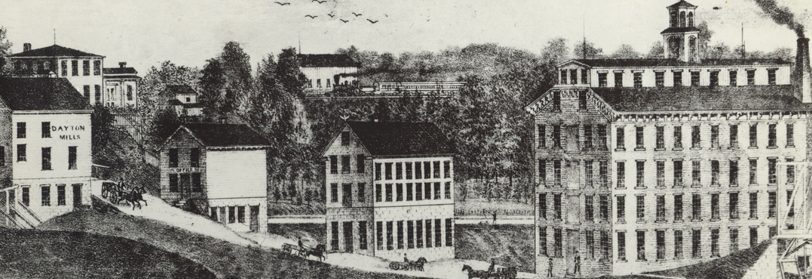

Memories of early Dayton by Maud V. Green (1866-1952)
There used to be “basket meetings” at the Sulphur Spring on Sundays in the summer. Preaching in the morning & afternoon with a picnic dinner and visiting between. Also we met our friends at the Old Settlers’ picnic, and at the County Fair when we always took our dinners & ate on the ground. Reunions at home were not so pleasant for the children, who had to wait for the “Second Table.” Times have changed for the better, for the children!
In the summer (before we had screens), the fly-broom was a useful thing. Paper was sewed around a long stick and slit into strips and inch or so wide & this was waved over the table to chase the flies. Also we had wire covers for some of the dishes (like a round strainer) and a glass cover for the butter dish, jelly, etc.
We had wood-stoves until in the nineties we got a hard-coal heater for the two front rooms. Always a big wood-pile and plenty of chips for starting fires.
We had a Singer sewing machine as long ago as I can remember & Mother got a bolt each of bleached & unbleached muslin & sewed and sewed all through January. Then in February it was carpet-rag time and we all sewed & wound carpet-rags & sent them to the weaver. The new carpet went in the “sitting room” and the others were moved back until at last they reached the kitchen & were worn out there.
I can just remember Grandma [Barbara Green] making candles for us to carry upstairs. They were afraid to have us carry a lamp, but we had lamps as long ago as I remember.
Grandma spent her time knitting socks and long stockings for all of us, out of factory yarn, and we had woolen underwear, skirts and dresses made of factory flannel.
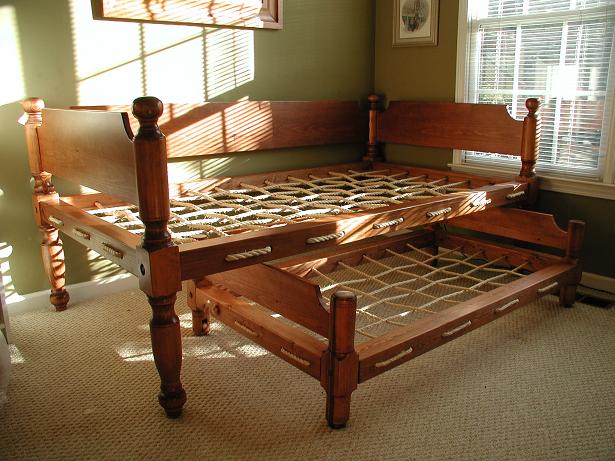
Uncle David’s house had the only Franklin stove I ever saw and the only trundle bed. A trundle bed was a low bed that rolled under the mother’s bed in daytime & was drawn out at night for two or three little folks who had outgrown the cradle. The “Franklin stove” was a little stove in the living room & had two doors that when opened made it like an open fire.
(see here for more information on Maud)
 Dayton and the Greens
My great grandfather John Peter Gonigam was living in Walnut, Illinois in 1893, and among other the ways he earned money for his family during the Panic of 1893 after his farm was wiped out by falling prices, was selling Singer Sewing Machines.
(from his biography by his son L.V. Gonigam) “The Singer Company offered him the agency in Ottawa, and we moved there in the fall of 1894, residing first at 1014 Ottawa Avenue. The sewing machine business proved to be rather good, and we moved to a house on Marcy Street in South Ottawa, where we could have a cow, chickens, and a small garden, in addition to the necessary driving horse. At about that time, three of the five big glass factories in Ottawa announced the ending of operations and transfer to Muncie, Indiana to get advantage of the natural gas fuel. Sale of sewing machines was ended, and the painful task of trying to repossess or collect balances on the outstanding machines began. There was no more income, and Dad finished up about $300.00 short on accounts where he had advanced payments trying to keep accounts alive. That sum was more than a year’s pay at the going rate of $1.00 per day for unskilled work.”
It is probable that J. P. sold many of his sewing machines in Dayton township. It’s even possible that a few of those well-made machines are still working in homes today. I wonder what the Panic of ’93 and its slow recovery, the failure of hundreds of state and national banks, and railroads constantly going into receivership did to the residents of Dayton? The Panic was world wide and caused a lot of immigration to the US. Did some of them become residents in Dayton? I suspect so.
LikeLike