BIOGRAPHICAL SKETCHES
Old Settlers
Mrs. SALLY TRUMBO PARR
‘Tis bound by a thousand bands to my heart,
Not a tie will break, and a link will start;
Would you know the spell? – a mother is there!
And a sacred thing is that old arm chair.
And gentle words that mother would give
To fit me to die and teach me to live!
She taught me to lisp my earliest prayer.
“Relict of William Parr, Esq. marriage occurred in 1828, came to this county in 1830. Mr. Parr helped to defend Ottawa during the Indian war.”—Hist. La Salle Co.
There is seldom a brighter day in January than last Thursday, which found us at the door of the residence of Mr. John T. Parr in Rutland. The roads, notwithstanding some patches of ice lingering here and there; some deep drifts in the timber; some water occasionally gathering up the lavish sunbeams and dashing them in our faces,–the roads were smooth and good.
Not far from the door where we stood was a portion of the tree still standing, against which the fire was built and the supper cooked on that autumn day, fifty-six years ago, that ended their four weeks journey to the new home. It was two years and a few months after their wedding, and “Sally” was only twenty-three. Two other couples were with them in this “picnic;” Mathias Trumbo and Rebecca Grove, David Shaver and Mary Grove. Pretty names, all of them. But these young people were getting fagged out, and provisions were getting low, and even the bake kettle and spider and coffee pot had a chopfallen and weary look after having been pulled out and loaded in again so many nights and mornings on the long journey.
I think, William, now that we have got here, that bake oven, wash tub, spinning wheel and the splint-bottomed chairs might as well stay out and give us a little more room in the wagon, since it’s not going to rain and we have got to sleep there nights for a good while yet.
We suspect it was a little crowded, though their worldly store was not great. Neither were their necessities great. In Licking county, Ohio, it was too new for the children of pioneers there to reckon on a large store of luxuries in starting out in life. The district school was not there, and not every one could afford to pay much or often for the teaching given in the private school. The wife of the second president of the U. S., Mrs. Abigail Adams, never had a day in school; yet taught at home she had an instructed and disciplined mind. The daughters of Jefferson had some education in Paris. The pioneer of that day could not send his children to Paris. If he had a book at all, often he had not a candle to study it by, but like Julian M. Sturtevant, for half a century connected with Illinois College at Jacksonville, had the evening school alone, with the book, and for a light a pine knot burning in the “Old Log Cabin Home.”
There were chopping and clearing for the boys, and milking, carding and spinning for the girls; caps to be made for the baby, and hats to be braided for the boys, &c, &c. Well, no matter, there was a good deal to do just now in this new settlement. We have got to select a spot for our house; find a good spring of water; cut some grass for the horses, and to fill a bed, thatch a shed and make arrangements to get a place to live, so that we can get out of the wagon as soon as possible.
These sturdy young folks have come here to make a living: gentle reader, do you know what that means? Those hands of theirs, and the few tools, and that dusty old bag with seeds, the horses and the cows, from the bosom of this earth, and from this overhanging sky, must bring to them henceforth their dwelling and their bread. These must bring the money and clothing that shall be hospitably offered to others at their table, or provided for their children: all that which they shall do to build roads and bridge streams and build up institutions as the school house, or church, or court house, or jail; by taxation to maintain in this land a government with army and navy. They are to be creators of all the good in which they hope to share. To make their living in God’s name; decently and above board, that is their errand here, and the work is now begun. No man could have foretold the rough winter before them, and no man since has seen snows so deep. They must needs have fodder, straw &c, from Green’s, at Dayton. The Shavers, with four yoke of oxen, started in the morning to go there; they got back at nine at night, having made but a mile and a half. After that winter, deer, turkies, chicken and quail were a long time scarce; wolves could live, but not much besides.
The second summer they got in some “sod corn” which did not ripen well and made poor bread; often it must be dried. One device for grinding was fixing a pole like the old fashioned well-sweep and with a stone pestle at the end, on a hollow stump of a tree do the pounding. The fine meal could be sifted out as flour, and the coarser made into hominy.
THE INDIAN WAR
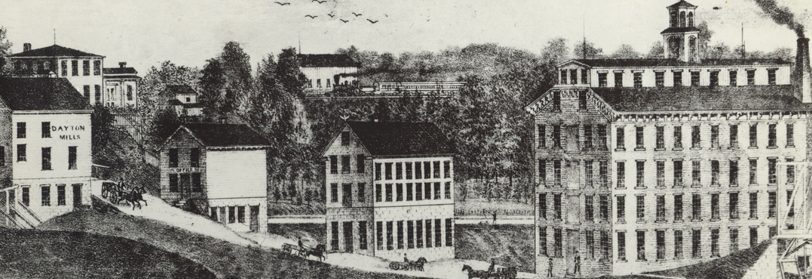
afforded diversion for the second summer. The Parrs and Trumbos first went to Green’s at Dayton, whose
cabin was trenched round and had something of a stockade.
They were safely housed there the night after the massacre at Indian creek, (May 20). George E. Walker came in the night to get a horse and whispered the sad news “Fifteen mangled bodies, and the two girls, Sylvia and Rachel Hall, of 17 and 15 years, carried off by the murderous savages.”
“JUMP UP QUICK, FOR GOD’S SAKE,
and go to Ottawa as fast as possible.” All were to walk who could, the rest to load into the “dug-out” and go by water. Mrs. Parr, Mrs. Pitzer and others walked, one of the boys having a loaf of bread for the commissary department.
The horrors of such affright can not be told save by those who have lived close at hand and in constant fear of the tomahawk and scalping knife. In Ottawa (South side the river) they did not know where to go; people were crowded in and families were scattered. David Walker’s and Joseph Cloud’s were the only houses then under the bluff. The next day the soldiers came and the fort was built on the South bluff.
The population being so small and the anxieties so great, gave a dismal outlook. In June a party with a few soldiers started to go to look after what might be left of their homes and substance at Mission Point and Holderman’s grove up east side of Fox river. Schermerhorn and Hazelton, his son-in-law, went up the west side and crossing over at Dayton were a half mile or so behind the others. Discovering a party of Indians they started their teams to fly towards Ottawa, but they were overtaken and killed. That same party, evidently, surprised that same day Capt. McFadden, Beresford and the Warrens, strawberrying on the south side of Indian creek, killing young Beresford.
Mr. Parr after a time ventured out and sowed a little buckwheat to provide against the possibilities of the next winter. It was not until the last of August that tidings of success in killing of the most of Black Hawk’s band, and of peace came, so that the families left returned with some sense of security to their desolated homes. Practically, that season was lost to husbandry, even when lives had not been taken. The plague of cholera, too, had spread its pall over the land. The story of Scott’s poor soldiers is well remembered.
Brighter days and more secure from foreign foe came the next summer, but chills and fever and other ills which flesh is heir to, came. For a time Mrs. Parr went every other day a mile and a quarter to care for Mrs. Keyes, (Walbridge) whose husband had gone east.
The years sped joyous or sad. The crash of 1837 came, and banks “burst.” In 184 [sic] Rev. Charles Harding coming to Freedom, often “preached at our house, in our barn, at Trumbo;s or at Grove’s barn.” A “good preacher”—it mattered not where, and small chance for beautiful “soft” essays or philosiphizings and clap trap, then and from him, where men, ten years without it, needed genuine unadulterable gospel and salvation.
The delusive song, beguiling the unstable,
“Nothing either great or small
Remains for me to do.”
was not then invented. Religion was business, a something to do. To get well a going in it a man must stir round, repeat, believe the gospel, and obey the Lord Jesus Christ. The “old Adam” must be shucked off, stove all up and laid aside entirely, (except on rare occasions). If one did not become pious, straight up and down, flatfooted, through and through, seven days every week, what was he “saved” from? He had not got in the “first installment” and it was no use to talk of “the balance in one, two and three years.”
But this is digressing from the line of our story.
After the Black Hawk war there were still (friendly) Indians around. They came, two and three families together, and would camp nearby. The men had their games and plays, fun and noise at beating.
The women would want to swap venison for flour and meal, and sometimes would banter to swap babies. They gleaned harvest fields, gathering up everything, some times getting a bushel of grain which they would take to Green’s mill.
Added years found a better home and larger substance for the mother, children, anxieties and toll, children to be fed clothed and schooled if possible; set to work; to be wrought into and wrought upon; filled with principles to bear a manly part on the great world plane. Who can realize and state it all; this mystery of home-life and nurturing and a pious mother’s care and prayer. The character to be given and impressed for today; to have and to hold with the outlook of eternal years.” Will children ever realize it? It was in 1858 that the husband died, after thirty years of married life; it lacks a little of thirty years. The sons, Henry K., Samuel E., and John T., are the centers of families near by. The daughter Mary (Mrs. Grove) who for six and twenty years had been her companion, deceased after a few weeks of married life. The mother in the eightieth year, on the border land, sees many of kindred and friends on either side its narrow sea. With great comfort in her bible, and with faith in the unseen Lord, she tarries, going still the rounds of duty. Erect, cheery, with elastic step, she greets you at the door, and in parting gives you the hand and pleasant good bye. We respond, God be with you, good bye.[1]
[1] Ottawa Free Trader, February 5, 1887, p. 8, cols. 3-4
 Dayton and the Greens